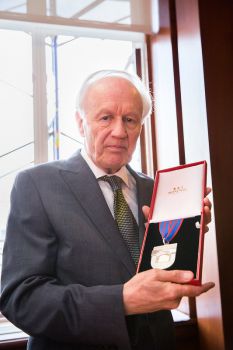
Sir Anthony Legett, taken in New York in 2014 with his University 50th Anniversary Gold Medal
Professor Sir Anthony Leggett, Fellow of the Royal Society and a former Professor of Physics at the University of Sussex, has died.
He worked at the University from 1967-1983, and his research during that time, on the theory of superfluids, led to him being awarded the Nobel Prize for Physics jointly with Russians Alexei Abrikosov and Vitaly Ginzburg in 2003.
Sussex Vice-Chancellor, Professor Sasha Roseneil said: “Professor Sir Anthony Leggett was an extraordinary scientist whose pioneering insights transformed our understanding of the physical world. His groundbreaking theoretical work at Sussex stands as a testament to someone who never stopped pushing the boundaries of knowledge.
“We are deeply saddened by his passing, and we honour his remarkable legacy as a Nobel laureate, a former Sussex colleague, and a visionary whose efforts continue to inspire generations of physicists. On behalf of the University of Sussex, I extend our heartfelt condolences to his family, friends, and the global scientific community who mourn his loss.”
The following obituary was written by a former PhD student of Sir Anthony, Professor David Waxman of Fudan University, Shanghai:
It is with a mixture of sadness and immense gratitude that I remember my PhD supervisor, Professor Sir Anthony Leggett – Tony to all who knew him. He passed away recently, leaving a legacy that spans the most subtle realms of theoretical physics and personal acts of kindness and generosity.
I was a student of Tony at Sussex from 1980 to 1984. His death has set me thinking about Tony and memories from 45 years ago to the present. Tony was full of contradictions. A Nobel Prize winner who thought nothing of travelling by Greyhound bus. A proper giant in his field, yet unassuming and, outside of physics, unknown.
He started as a lecturer at Sussex and worked his way up to professor. It was at Sussex in the 1970s that he did the work that eventually led to the Nobel Prize in 2003. It concerned liquids at ultra-low temperatures, where the remarkable effects of quantum mechanics emerge. I think it is fair to say that Tony could look at what everyone else dismissed as a minor glitch on a graph and recognise it as signalling something completely new. He provided an explanation of superfluid helium-3 – where atoms of a rare isotope of helium pair up at only a few thousandths of a degree above the lowest possible temperature. Tony was extraordinarily sensitive to what nature was trying to say.
I remember one moment that still makes me smile. After he received the Nobel Prize, Sussex awarded Tony an honorary degree. I was a faculty member of Sussex at that time and was asked to introduce him at graduation. I mentioned quite casually to the audience (consisting mostly of parents of graduating students) that he'd won the Nobel Prize and expected everyone to know this. However, a ripple went through the audience, followed by this spontaneous eruption of applause. They did not know who he was and what he had done.
Later, he did tremendously influential work on quantum tunnelling (leakage of particles through barriers due to their wave effects) - in particular, on the quantum tunnelling of "large" objects. Much of this work was at Sussex with his PhD student Amir Caldeira, mostly in the 1980s. His ideas directly inspired experimental physicists for decades. When they awarded the 2025 Nobel Prize in physics for quantum tunnelling, one of the winners explicitly mentioned Tony's work as the motivation for their experiments.
Tony met his wife Haruko at Sussex. They lived near Fiveways, in Brighton, and had a daughter, Asako. I have a clear picture of him coming into the University at some early hour in the morning to get his marking done and then leaving around 3:30pm to collect Asako from school.
Halfway through my PhD, he announced he was off to the United States and asked if I would like to come along. That one question led to me visiting Stony Brook University, Cornell University, and finally the University of Illinois Urbana-Champaign – where Tony spent the rest of his career. I particularly remember one journey, I think from Cornell. We travelled by Greyhound bus, stayed overnight in a basic hotel in Cleveland, and eventually made it to Urbana. I'm fairly sure we could have afforded to fly. But that was Tony – completely indifferent to what anyone else might do, living exactly as suited him.
He ensured his PhD student, in a strange country, had somewhere to stay, and repeatedly checked I was alright. And he remembered people. For almost 45 years, every Christmas, a card would arrive, covered in his characteristic microscopic handwriting.
I remember Tony, when talking about learning Japanese, said you only really know a language when you start dreaming in it. Then, laughing, he said that his Japanese teacher told him he said things that were grammatically correct but that no Japanese person would ever say.
One evening, by pure luck, Tony and another Sussex legend, the biologist John Maynard Smith, ended up at my house in Lewes. They sat together on the sofa and between them explored the physical and biological universes. My real regret is that I did not record that remarkable conversation.
Tony once said that education should give you confidence to try new things. He certainly gave me that. Not just through his science, but through his example – the way he combined that formidable intelligence with genuine kindness, the way he lived modestly and thought deeply. He had the highest of intellectual standards, but he wasn't after rigour for its own sake. He wanted correctness and clarity. He was a theoretical physicist who never reached for fancy mathematics but just started from first principles and got to the heart of the matter his way, following his conception. His mind was properly open – if there was reliable data on something, Tony would consider it, no matter how peculiar.
A few years ago, at a meeting held in his honour in Shanghai, it was evident just how many colleagues and students Tony welcomed throughout his career. I have no doubt that he has had a profound and lasting impact on all of them. This and his scientific contributions form an enduring legacy.