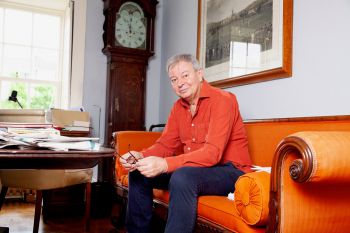
Adam Sisman
Writer and alumnus Adam Sisman will be conferred Honorary Doctor of the University at Sussex’s Summer Graduation 2026.
Award-winning biographer Adam Sisman was not, by his own admission, a diligent history undergraduate at Sussex in the early 1970s.
“In retrospect I am a little ashamed of myself,” he says. “I sometimes wonder, should I have been pushed harder? But actually, it's down to you, isn't it? You're supposed to be a grown-up.”
What Sussex did offer, however, was a “progressive, dynamic feel”.
“I had been at a very good school in London – St Paul’s – from which it was almost a shoe-in to get into Oxford or Cambridge. But I wanted to go to a university more in tune with the times. We were a generation that had been radicalised by the Vietnam War and apartheid in South Africa.”
He chose Sussex "for a number of worthy - and less worthy – reasons,” he adds. “One was that the ratio of sexes was roughly equal, which was not the case at either Oxford or Cambridge where many of my friends had gone. I had had enough of a single sex environment at school.”
He recalls attending a protest against Mary Whitehouse, who campaigned against what she called “the permissive society” and who had come to speak on campus.
“Some of the protestors had dressed up as nuns and were catcalling her. But when she started to describe some of the violent pornography she had seen, the mood changed pretty quickly to, well, maybe she's got a point. You know, some of this is pretty nasty stuff, very demeaning to women, and maybe we need to be a bit careful about it.”
There was plenty of student protest in those days. Sisman vividly remembers the Huntingdon affair, when the student union voted by a large majority against a campaign to prevent an American professor speaking on campus. “In the run-up to the vote there were a number of public meetings on campus to discuss the issue. I remember one meeting at which some of the students started mocking a member of the faculty who had a stammer. I didn’t like that.”
While acknowledging that he didn’t take full advantage of the academic opportunities on offer, he reflects that it was “…a happy time. I had a lot of growing up to do, and I probably did that at Sussex”.
From editor to writer
After leaving Sussex, Sisman worked in publishing for 15 years, rising to become editorial director at Macmillan. When he lost his job, his wife, novelist Robyn Sisman, was pregnant with their first child. “Two years later, when she was pregnant with our second child, she too lost her job.” Fortunately, he had discovered his metier. “I think I am better at writing than I was at editing. I also like being given a deadline and luckily I have never been short of commissions.”
His first book, a biography of the historian A.J.P. Taylor, was shortlisted for the 1994 Duff Cooper Prize. His second, Boswell’s Presumptuous Task (1999), won the US National Book Critics Circle Award.
Subjects of his other major biographies include the spy novelist John le Carré, and historians Hugh Trevor-Roper and Asa Briggs (who was Vice-Chancellor of Sussex 1967-76). “I think I can claim to be the only person alive to have written biographies of three historians,” he says ruefully. “I am in danger of becoming stereotyped”.
He has also edited volumes of letters of Trevor-Roper and of travel writer Patrick Leigh Fermor. Among his other books is a study of the collaboration between the poets Wordsworth and Coleridge. “I have always been interested in both literature and history – oscillating between the two,” he says.
He is now an Honorary Professor of History at St Andrews, and a Fellow of the Royal Society of Literature. He has written “dozens, probably hundreds” of articles and book reviews for newspapers and magazines, and has made numerous media appearances, often discussing the subjects of the biographies he has written.
Briggs' biographer
His biography of Asa Briggs, who was Vice-Chancellor at Sussex when Sisman was student, was published in 2025. He was invited to write it by Briggs’ widow, Susan, gleaning the information he needed from Briggs’s enormous archive, from interviews with those who had known him and from the former Bletchley Park codebreaker’s own memoirs – “rather unreliable, I’m afraid”. Sisman was startled to find himself namechecked in Briggs’ memoirs, as having written two “well-received biographies” of historians. Later he found a reference to the possibility of a biography in one of Briggs’ handwritten diaries. “Sisman would be my first choice,” Briggs had written.
Sisman had interviewed Briggs himself in 2008, while researching Trevor-Roper’s posthumous biography, and had been surprised when Briggs claimed to remember him as an undergraduate at Sussex.
“He never taught me and I’m pretty sure that we never met. I think that he was just being nice. Back when I was at Sussex the general impression of him was as a sort of liberal, benevolent figure, only ever seen marching across campus at top speed, with assistants running behind him with bits of paper.
"He was notorious for conducting tutorials on the train to London or even, it was said, in the departure lounge at Gatwick. People joked that if you wanted a generic term for a unit of energy, you could call it an Asa!”
During a Q&A with current Vice-Chancellor Professor Sasha Roseneil last year, Sisman revealed that Briggs, whose phenomenal intelligence and capacity for work enabled him to simultaneously graduate with firsts from both Cambridge and the London School of Economics in different subjects, was a difficult person to get to know, even if his principles were transparent.
“His vision of Sussex was a utopian one, reflecting his belief in education as a force for overcoming social injustice.”
Sisman says there is a big difference between writing biographies of the long dead and people who have only recently died, or who are still alive.
“A biographer is in a privileged position, somewhat like a detective or an analyst. You are likely to uncover secrets and what you write may cause upset within the family. In some ways, you get to know a subject better than they know themselves,” he says. “The real joy of writing biographies is that learning about the lives of others enriches your own life.”