
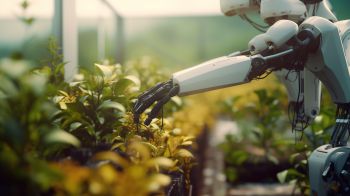
Robot picking leaves
The use of AI is a double-edged sword: it has the potential to facilitate access to environmental justice, while also having significant environmental impacts through its growing demand for energy, water and natural resources. AI, is a constellation of several technologies working together to allow machines to sense, understand, act and learn with human like levels of intelligence. On the one hand, AI has many benefits and can support the efficient implementation and effectiveness of environmental regulation that can be complex, expensive and time consuming. Yet the use of AI in environmental matters places environmental lawyers in something of a quagmire: whether to embrace AI for its potential to improve environmental governance and access to justice, or to exercise caution given its significant environmental impacts, including rising greenhouse gas emissions, energy consumption, water use and pressures on ecosystems.
AI offers significant benefits for environmental regulation by helping to predict environmental risks, inform policy decisions, and monitor compliance with environmental laws and regulations. Monitoring compliance is crucial, because the implementation of environmental law and policy is slow. Using AI can facilitate real-time monitoring, enforcement and identify areas that require immediate intervention rather than relying on the good faith of stakeholders to implement policies. For example, the AI model YOLOv10 was developed to improve conservation efforts for vulnerable curlews in Wales, and the results of the model demonstrated high accuracy in Curlew detection and supported monitoring of curlews and their chicks during nesting season. It is evident that AI can support ecological research and enhances monitoring and conservation efforts.
Access to justice, is access to a review procedure before a court of law or another independent and impartial body according to article 9(1) of the Aarhus Convention. The intersection of AI and access to justice, expands the ability of underrepresented communities to advocate for themselves and their natural environments and identify environmental needs and harms. For instance, in Sanikiluaq, Canada, a combination of AI systems and Indigenous knowledge have been used to keep track of climate change, close data gaps and support mariculture. This demonstrates the blend of technology with traditional knowledge, which can strengthen resilience and local livelihoods.
Despite these benefits, it is known that AI poses a serious risk to the environment. AI requires copious amounts of fresh water to prevent from overheating and electricity. The United Kingdom is the third-largest host of data centres with an estimate of 477 in use and many more planned. According to the National Energy System Operator (NESO), the increase in data centres will add up to 71 TWH of electricity demand in the next 25 years, and would require additional electricity generation and network capacity, increasing both climate emissions and potentially consumer bills. In Potters Bar, Hertfordshire, residents objected to a £3.8bn cloud and AI centre on the green belt and in Dublin, a moratorium on building AI revealed a strain on Ireland’s electricity power in 2021. This illustrates the impact of building data centres on important biodiversity and green spaces, and the stress AI puts on the environment through its high consumption of water and electricity.
The increased popularity of AI and its benefits could be better reconciled with environmental impacts through stronger regulation of AI, by taking environmental matters seriously, rather than prohibiting its use. The United Nations Environment Programme (UNEP) recommends that countries should ensure companies: (i) green their data by using renewable energy, (ii) disclose the environmental impact of their AI-based service or product and (iii) take the proactive step of integrating AI policies into environmental regulations. These guidelines provide a basis for the regulation of AI and can be adapted in different contexts.
There is a clear tension between the growing demand for AI and the need to protect the natural environment, and this reinforces the need for stronger governance of AI and legal frameworks that take environmental concerns over AI seriously. Ultimately, without healthy ecosystems and a thriving natural environment, the long-term development and sustainability of technologies such as AI will itself be at risk.